 Open 7:30 AM – 5:00 PM MON-FRI
 Located in the Montavilla Neighborhood 707 SE 82ND AVE. PORTLAND, OR 97216
 503-254-7310

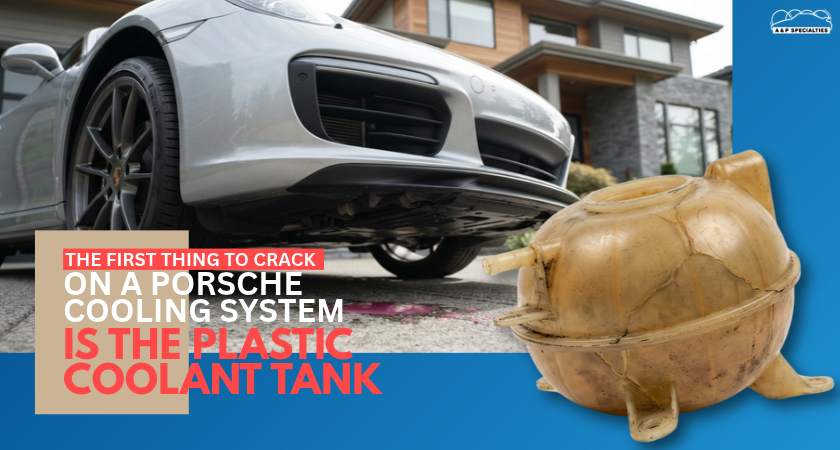
A sweet smell in the garage, a chalky white crust somewhere behind the engine, and a coolant level that was full a month ago. That combination arrives at our counter on 82nd Avenue all winter, and on a Cayenne, Boxster, Cayman or 911 the part behind it is usually the expansion tank. Portland drivers tend to suspect the radiator or the water pump first. Those fail too, but later, and they rarely fail this quietly.
Quick Summary: Key Takeaways
- Where it splits: the molded seam around the tank body, or the neck the pressure cap screws onto.
- What you notice: a sweet smell with no puddle, white or pink residue, and a low-coolant message that keeps coming back.
- Why cold weather finds it: plastic shrinks when it cools and expands when the engine heats it, and a hairline crack works open on that cycle.
- What it costs to wait: a weeping tank can let go completely and empty the system in well under a minute.
The tank sets the pressure the entire system runs on
That reservoir is not an overflow bottle. It is sealed, it is part of the pressurized circuit, and the cap on top is a calibrated relief valve. Raising the pressure raises the boiling point of the coolant. That is how a Porsche runs its coolant hotter than plain water boils without turning any of it to steam.
Lose the seal and you lose the pressure. The coolant starts to boil at a lower temperature, steam pockets form where there should be liquid, and the engine runs hot in exactly the conditions it used to handle. The gauge may not move much. The damage does.
Plastic ages from the inside
The tank is made from a glass-reinforced polymer because it has to survive heat, pressure and coolant chemistry at the same time. It does that well for years. Then the resin between the glass fibers embrittles, usually along the molding seam where the two halves were joined, and the part loses its ability to flex.
Mileage matters less than heat cycles here. A garage-kept 911 driven on weekends can crack a tank on age alone, while a daily-driven Cayenne gets there through sheer repetition. Either way, once the plastic has gone brittle, no sealant or epoxy holds it. We have seen patched tanks come back in a week.
The leak announces itself before the gauge does
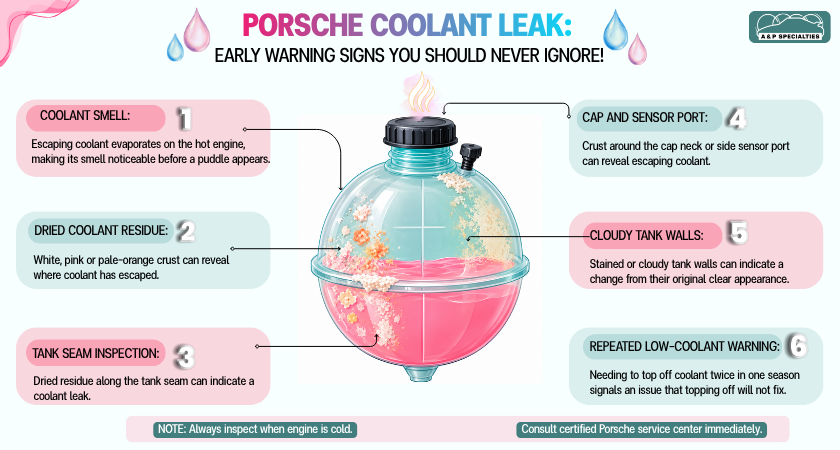
Coolant that escapes onto a hot engine mostly evaporates, so the smell shows up long before a puddle does. What it leaves behind is the dye and the additive package, dried into a crust that is white, pink or pale orange depending on which coolant is in the car.
Look at the tank with a flashlight when the engine is cold. Trace the seam. Check the neck under the cap and the small sensor port on the side. Crust anywhere on that path is the answer, and so is a tank wall that looks stained or cloudy from outside when it used to be clear.
The low-coolant warning is information worth acting on. The level sensor sits in the tank for a reason, and a car that needs topping off twice in a season is telling you something that no amount of topping off will fix.
Antifreeze on the driveway is a real hazard
Ethylene glycol is the base of most coolants, and the federal Agency for Toxic Substances and Disease Registry warns that exposure to large amounts damages the kidneys, nervous system, lungs and heart. The same agency reports that ethylene glycol in soil breaks down over several days to a few weeks, so a spill on the driveway does not simply disappear overnight.
That matters if you park where a dog, a cat or a curious toddler can reach the spot. Soak up what you can, rinse the area, and get the leak closed before the wet months arrive.
What the repair involves
Replacing a Porsche expansion tank is not a long job on most models, but it is a job that rewards care. The tank comes out with its cap, its level sensor and the hoses that clip into it, and every one of those clips is also aged plastic. Reusing a brittle clip on a new tank is how a shop gets a comeback.
After the new tank goes in, the system has to be filled properly and purged of air. A Porsche cooling system will hold an air pocket that makes the car run hot even though the tank reads full, so the fill is done under vacuum and then checked with the engine at temperature. We pressure-test before and after, which also catches the hose or radiator seam that was quietly weeping alongside the tank.
Frequently Asked Questions
Q: How long can I drive a Porsche with a leaking coolant tank?
A: Plan in days, not months. A seeping tank is survivable while you get an appointment, but the failure mode is sudden — the crack opens under pressure and the system empties quickly, usually while the engine is hot.
Q: Can a cracked coolant tank be repaired instead of replaced?
A: No. The plastic has become brittle across the whole part, so a patch simply moves the next split a few inches. Replacement is the only repair that lasts.
Q: Why does my coolant light come on when the tank still looks full?
A: Either the level sensor has failed, or there is air trapped in the system holding the level up artificially. Both are worth sorting out, because an air pocket causes overheating that the gauge is slow to report.
What Happens When You Bring It In
If your Porsche smells sweet after a drive or you have topped off the coolant more than once this year, have the tank looked at while it is still a small job.
A & P Specialties — 707 SE 82nd Ave, Portland, OR 97216
aandpspecialties.com
→ Use the Schedule Appointment button to book a cooling system check