 Open 7:30 AM – 5:00 PM MON-FRI
 Located in the Montavilla Neighborhood 707 SE 82ND AVE. PORTLAND, OR 97216
 503-254-7310
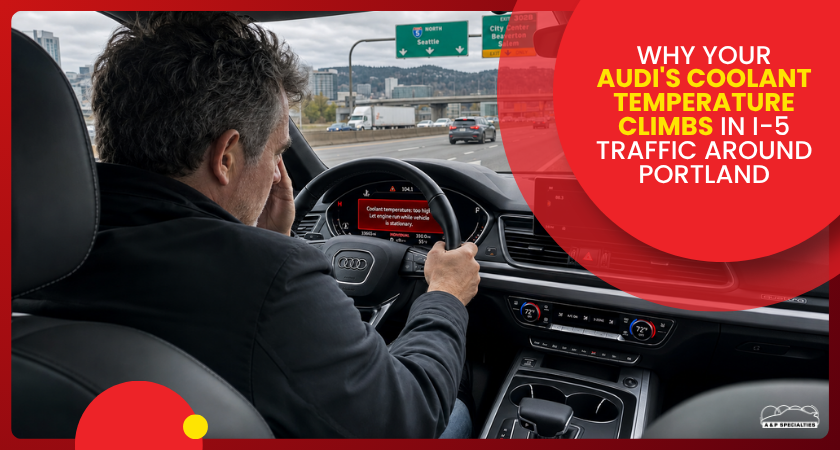
You’re crawling north on I-5 through the Rose Quarter on a 90-degree afternoon, the AC fighting to keep up, and the coolant gauge is sitting higher than it should. That’s not your imagination. Stop-and-go traffic plus summer heat is the exact load that drags a tired Audi cooling system out into the open, and it usually happens on the hottest day of the week.
On a VW-Audi engine, a small coolant problem does not stay small when it’s hot out. A weeping thermostat housing or a cracked coolant flange can turn into a warped head and a four-figure repair in one bad afternoon. So don’t push it. If your Audi runs warm in Portland traffic, get it looked at before your next drive south to Salem.
Quick Summary: Key Takeaways
- The gauge is the tell: A needle drifting past center in traffic means the cooling system is already struggling.
- Audis have known weak spots: Plastic thermostat housings, coolant flanges, and water pumps fail sooner in heat.
- Idling is the hard part: Airflow drops in stop-and-go traffic, so a marginal fan or pump shows up on I-5.
- Don’t drive it hot: A $200 flange can become a $4,000 head job if you keep going.
- We back the work: Qualifying repairs carry our 36-month/36,000-mile warranty.
What the Climbing Gauge Is Telling You
The rising needle is an early warning, and it’s worth heeding. On a healthy Audi the coolant temperature holds dead steady near the middle of the gauge no matter how bad the traffic gets. When it starts creeping up as you idle on I-5 — or the vents blow warm right when you’re begging for cold air — the system is quietly losing its grip on engine heat. That’s your cue.
Catch it here, and the fix is cheap. Wait for the red zone or a coolant light, and you’re often paying for damage a $200 part would have stopped. Heat kills these engines. Miles don’t.
Why VW-Audi Cooling Systems Run Hot When It’s Warm Out
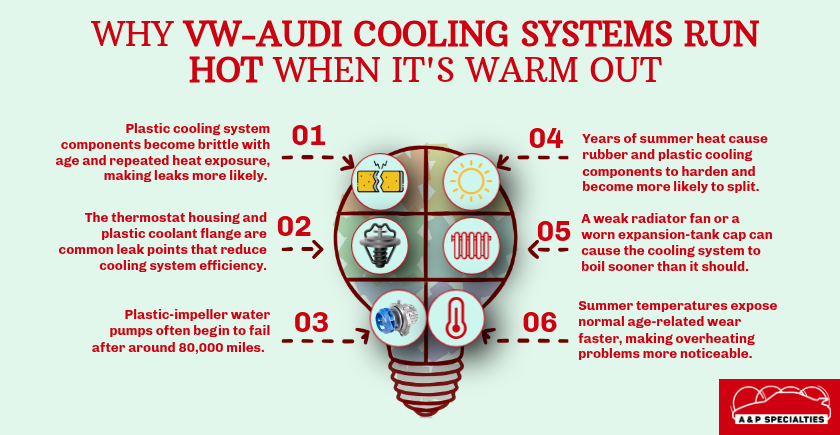
Audi cooling systems use a lot of plastic, and plastic gets brittle with age and heat. The thermostat housing is a known leak point on the 2.0T and the older 3.2, the plastic coolant flange at the back of the head cracks and weeps where you can’t see it, and the water pump — often a plastic-impeller design on these engines — tends to give up somewhere north of 80,000 miles. Ten Portland summers add up. By then most of the rubber and plastic in the system is hard and ready to split.
Add a weak radiator fan or a tired expansion-tank cap that won’t hold pressure, and the whole system boils sooner than it should. None of this is exotic. It’s ordinary German-car wear, and summer just finds it faster.
Why Stop-and-Go I-5 Traffic Makes It Worse
Cooling systems fail under load, and nothing loads an Audi like idling in traffic on a hot day. At highway speed, air rams through the radiator on its own. Sit dead still on I-5 near the Terwilliger curves with the AC compressor piling heat onto the system, though, and the engine leans entirely on one electric fan to move air — so a fan that’s 80 percent healthy limps through spring and finally can’t keep up in July. Load finds the weak spot.
Summer road trips stack the odds higher. AAA expected to rescue 7.7 million drivers over the summer of 2025, and an overheated cooling system is one of the top reasons a run to the coast ends parked on the shoulder of Highway 26.
Why You Don’t Limp an Overheating Audi Home
Keep driving an Audi that’s running hot, and you gamble the whole engine to save a tow. When coolant temps spike, the aluminum head warps and the head gasket lets go. A cracked coolant flange? A couple hundred dollars in parts and an afternoon of labor. Cook the head gasket on the way home instead, and you’re staring at a $3,500 to $5,000 repair, sometimes more on a turbo motor with the timing components in the way.
The math isn’t close. Pull over, shut it down, let it cool — or get it towed if the gauge is buried. We’d rather see your car on a flatbed than up on our lift with the head already off.
How We Find and Fix a Cooling Problem
We start with a pressure test and factory-level diagnostics, not a guess. That tells us whether you’re losing coolant outside at a housing or hose, or inside past a gasket. From there we replace what actually failed — the thermostat housing, coolant flange, water pump, or radiator — and refill with the correct G13 Audi coolant instead of a generic jug off the parts-store shelf.
Speed matters when it’s this hot. Most cooling jobs go out same day or next, and every qualifying repair carries our 36-month/36,000-mile warranty. We’ve kept Portland’s Audis, Porsches, and VWs running from our shop on SE 82nd since 1985, and we won’t sell you work you don’t need. Straight answers. Fair prices.

Frequently Asked Questions
Q: Why does my Audi’s temperature gauge go up in traffic?
A: Because airflow through the radiator drops when you’re stopped, so the engine leans entirely on the electric cooling fan. If the fan, water pump, or thermostat is marginal, the gauge climbs in stop-and-go traffic on a hot day. A pressure test and a fan check pinpoint the cause fast.
Q: Is it safe to drive an Audi that’s running hot?
A: No. If the coolant gauge climbs into the red or a warning light comes on, pull over and let it cool. Driving an overheating engine is how a cheap coolant repair turns into a warped head or a blown head gasket. Get it towed if it won’t cool down.
Q: How often should Audi coolant be changed?
A: Most VW-Audi engines call for a coolant service around every four to five years, and the plastic components are worth inspecting at the same visit. In Portland’s hot summers, having the housing, flange, and hoses checked before a road trip is cheap insurance against a much bigger bill.
Get Your Audi’s Cooling Checked Before Your Next Summer Drive
Coolant gauge creeping up on I-5? Bring your Audi in before your next trip down the valley.
A & P Specialties — 707 SE 82nd Ave, Portland, OR 97216
Hours: Monday–Friday, 7:30 AM – 5:00 PM; closed weekends
Website: aandpspecialties.com