 Open 7:30 AM – 5:00 PM MON-FRI
 Located in the Montavilla Neighborhood 707 SE 82ND AVE. PORTLAND, OR 97216
 503-254-7310
Quick Takeaways:
- Porsche cooling systems rely on parts that work hardest in summer heat.
- Coolant degrades over time, losing its corrosion and heat-transfer properties.
- Plastic coolant parts and water pump impellers are known wear items.
- Portland’s mild spring masks weaknesses that surface in the first 90-degree stretch.
- A & P Specialties at 707 SE 82nd Ave uses Porsche-specific diagnostic tools to pressure-test the cooling system.
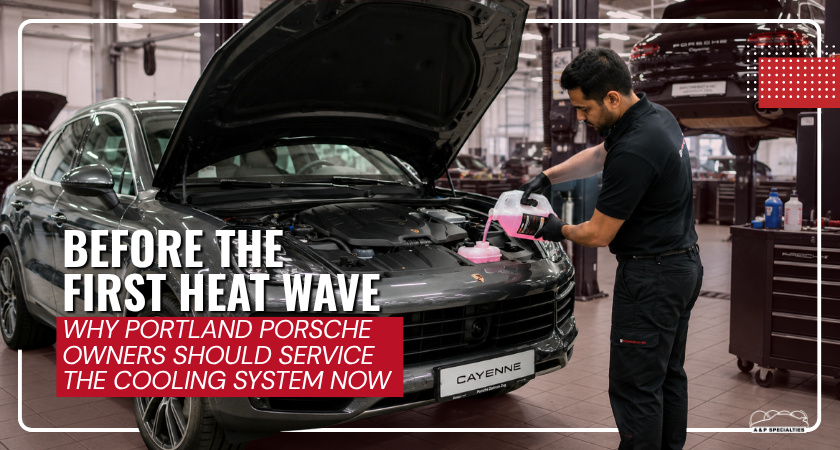
Portland Porsche owners get lulled by spring. The mild, damp months keep engine temperatures low, so a cooling system past its prime gives no warning — right up until the first heat wave or a loaded drive up I-84 through the Columbia River Gorge. That is when a marginal water pump, tired thermostat, or coolant that lost its additives years ago makes itself known, usually in slow traffic with the A/C blasting and nowhere to pull over. If you have summer road trips, track days, or coastal runs to Cannon Beach on the calendar, the cooling system is the part most worth attention now. A & P Specialties has serviced Porsche, Audi, and Volkswagen vehicles in Portland since 1985, and they see the same pattern every June — overheating problems that were entirely preventable in May.
Why does summer heat expose Porsche cooling system weaknesses?
A cooling system has plenty of margin when temperatures are low and the engine is barely working, which describes most of a Portland spring. Push it into 90-degree heat, sustained highway speed, a steep grade, or stop-and-go traffic with the A/C adding load, and the margin disappears. Components that were “good enough” in mild weather suddenly operate at the edge of their capacity, and the weakest link fails first.
On many Porsche models, that weakest link is predictable. Composite water pump impellers wear and shed, plastic housings and fittings become brittle with heat cycling, and the thermostat can stick. Coolant is a wear item too, losing the corrosion inhibitors that protect aluminum passages. If your Porsche shows temperature creep, sweet-smelling steam, or low coolant with no obvious leak, schedule a diagnostic at A & P Specialties before a marginal part becomes a roadside failure.
What cooling-system service should a Porsche get before summer?
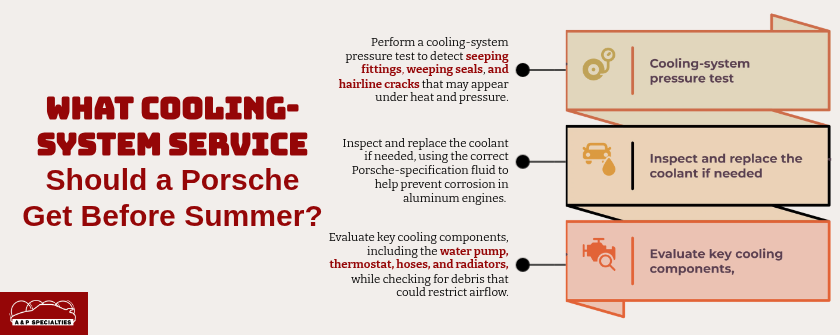
A proper pre-summer service starts with a pressure test of the entire system to find seeping fittings, weeping seals, and hairline cracks in plastic parts that do not leak at rest but open up under heat and pressure. From there, the coolant is inspected and, if past interval, flushed and replaced with the correct Porsche-specification fluid — the wrong coolant accelerates corrosion in aluminum engines.
The water pump, thermostat, hoses, and radiator condition all get evaluated, because replacing coolant without checking the hardware that moves it is only half the work. A & P also inspects the radiators, which on many Porsche models sit low at the front and collect leaves and Gorge dust that block airflow. Learn more about A & P Specialties’ Porsche service in Portland to see what a complete summer cooling inspection covers.
What are the warning signs of a cooling problem before it strands you?
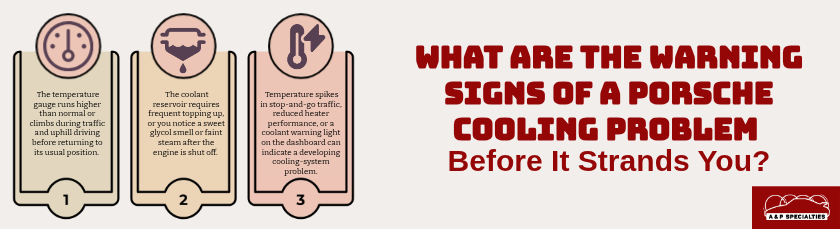
The earliest sign is subtle: the temperature gauge sitting slightly higher than it used to, or climbing on grades and in traffic before settling back. A coolant reservoir that needs periodic topping with no visible puddle points to an internal or pressurized-system leak. A sweet smell — glycol — or a faint steam wisp after shutdown both indicate coolant escaping.
More advanced symptoms include the temperature spiking in stop-and-go conditions (a classic sign of weak coolant flow or a failing pump), heater output dropping because the system has air in it, or a coolant warning on the dash. Per the U.S. Department of Energy, even routine cooling loads increase fuel consumption in hot weather — and a struggling system makes that worse while putting the engine at risk. None of these should wait for a convenient weekend.
How does Portland’s driving environment factor into Porsche cooling wear?
Portland gives a Porsche a deceptively easy life most of the year, then asks a lot of it in short, intense bursts. The summer climb up Highway 26 to the coast, the long pulls through the Gorge on I-84, and the heat-soaked crawl of city traffic on a rare 95-degree afternoon all stack thermal load onto a system that spent nine months barely breaking a sweat. That feast-or-famine pattern is hard on aging coolant and brittle plastic.
Cars that sit during the wet months and then get pressed into heavy summer service are especially prone to surprises, because seals and fittings fine under light use give way once asked to hold pressure at temperature. If your Porsche has not had a cooling inspection in the last couple of years — especially if the coolant’s age is unknown on a used purchase — have it checked before the first heat wave.
Frequently Asked Questions
Q: How often should a Porsche’s coolant be flushed?
A: It depends on the model and the coolant type, but coolant is a maintenance item with a defined service life, not a fill-for-life fluid. If your Porsche’s coolant age is unknown or past the interval, A & P Specialties can test its condition and advise whether a flush is due before summer.
Q: Can I keep driving my Porsche if the temperature gauge runs a little high?
A: Slight, consistent temperature creep is a signal to get it inspected soon, not to keep ignoring. A sustained overheat on an aluminum Porsche engine can cause expensive damage. Bring it to A & P Specialties for a pressure test before a long summer drive.
Q: Which Porsche cooling parts fail most often?
A: Water pumps, thermostats, and brittle plastic coolant housings and fittings are common wear points across many Porsche models, particularly as they age and get hit with summer heat load. A thorough inspection checks all of them.
Q: Does A & P Specialties service other European brands besides Porsche?
A: Yes — A & P Specialties services Porsche, Audi, Volkswagen, and a range of European vehicles in the Portland area. Contact the shop directly to confirm service for your specific make and model.
Contact
A & P Specialties
707 SE 82nd Ave, Portland, OR 97216
Phone: (503) 254-7310
Website: aandpspecialties.com
Hours: Monday–Friday 7:30 AM – 5:00 PM; Saturday & Sunday Closed